What Is an ETF, and Why Has It Become the Default Door to Investing?
Over the last twenty years one single instrument has reshaped how millions of Europeans invest: the ETF. Not because it's new — the first ETF launched in 1993 — but because it made possible, with a few euros and a few clicks, exactly what used to cost steep fees: buying the whole market in one shot.
This guide explains what an ETF really is, how to read its spec sheet on your broker's site, what the alphabet soup of acronyms (UCITS, TER, ACC/DIST, physical vs synthetic replication) actually means, and why in Italy the choice between accumulating and distributing share classes can be worth thousands of euros over twenty years.
ETF in one line
An ETF is a fund that trades on an exchange like a stock. With a single order — one click on Directa, Fineco, Degiro — you own a proportional slice of hundreds or thousands of different holdings.
Concrete example: you buy €1,000 of VWCE.MI (Vanguard FTSE All-World). In return you get a share that represents your slice of ~3,700 companies listed worldwide: Apple, Microsoft, Nvidia, ENI, Nestlé, Samsung, Toyota, and 3,693 others. You don't pick them. The index picks them (FTSE All-World), and the fund replicates it for you.
Why this is revolutionary: before ETFs, building a globally diversified portfolio meant either (a) individually buying hundreds of stocks with hundreds of commissions, or (b) paying a traditional mutual fund manager 2%+ per year. ETFs cut both: one order, a TER of ~0.22% per year for VWCE.
Passive investing: Bogle's wager
ETFs are synonymous with passive investing. The idea, pushed by John Bogle (Vanguard's founder, 1975) and academically grounded in the work of Eugene Fama and Kenneth French (economists behind the multi-factor model) and Burton Malkiel (author of A Random Walk Down Wall Street), is simple:
Most active managers don't beat their benchmark, net of fees, over long horizons. If you can't beat it, buy it.
SPIVA data (Standard & Poor's Indices Versus Active) has been telling the same story for twenty years: over 15 years, roughly 85-90% of active funds in any European or global equity category underperform their benchmark. Not because managers are incompetent — because management fees (1.5-2.5% annually) eat any advantage they generate.
The passive ETF sidesteps the problem: it doesn't try to beat the market, it just tries to track it faithfully at the lowest possible cost.
How to read an ETF spec sheet
When your broker shows you an ETF, six numbers matter. Take CSSPX.MI (iShares Core S&P 500 UCITS ETF) as an example:
1. ISIN and domicile
IE00B5BMR087. The first two characters indicate domicile: IE = Ireland, LU = Luxembourg. Almost every ETF available to Italian retail residents is domiciled there — for good European tax reasons. An ISIN starting with JE, CH or XS is not an ETF: it's likely an ETC (exchange-traded commodity), a different category with different tax treatment (see the tax article).
2. UCITS: what it guarantees
UCITS in the name means the fund complies with EU Directive 2009/65/EC. In practice:
- Max 10% of assets in any single issuer (concentration limits)
- Asset segregation from the management company (if the manager fails, your investment is safe)
- Daily NAV publication
- Standardized disclosure document (KIID/KID)
A non-UCITS ETF (e.g. some US products like SPY) may be excellent but isn't sold to EU retail. In Italy, you'll almost only buy UCITS.
3. TER — Total Expense Ratio
The all-in annual cost, quoted as a percentage of invested capital. For CSSPX.MI it's 0.07% per year — €7 a year on €10,000, scaled directly from the fund's NAV (no separate bill: the quoted price is already net).
Typical ranges:
- Broad-index equity ETFs: 0.07-0.25%
- Sector or thematic ETFs (fintech, AI, clean energy): 0.30-0.75%
- Actively managed ETFs: 0.60%+
- Traditional equity mutual fund: 1.5-2.5%
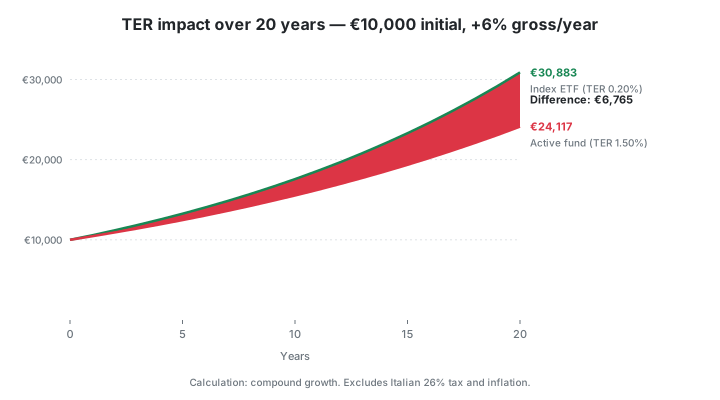
TER looks small but compounds. A 0.5% annual difference over twenty years on €50,000 invested: ~€7,500 in extra costs, compounded.
4. Physical vs synthetic replication
How does the fund actually "own the index"? Two paths:
- Physical replication (full): the fund literally buys every constituent of the index in the correct proportions. Feasible for small indices (FTSE MIB with 40 components), expensive for wide ones (MSCI World has ~1,500 names).
- Physical replication (sampling / optimized): the fund buys a representative subset, optimized to replicate returns without needing to own everything. Default for most large diversified ETFs (Vanguard FTSE All-World uses this).
- Synthetic replication (swap-based): the fund buys an ARBITRARY basket + a total-return swap with a bank that commits to paying the index return. The UCITS directive caps counterparty exposure at 10% NAV (controlled risk).
Synthetic replication was common for some categories (commodities) but is in decline. You check this in the KIID: "Replication method: physical / synthetic".
5. Tracking Error
How faithful is the fund to the index it's supposed to replicate? Tracking error measures the standard deviation of daily return differences between the ETF and its benchmark. A good global equity ETF has a tracking error below 0.1% annualized. Above 0.3% the replication is sloppy (or intentional, for partially active ETFs).
6. Accumulating vs Distributing — the tax choice
This is the practical choice many Italian investors get wrong. When the fund receives dividends from the stocks it holds, it can do two things:
- Accumulating (ACC): reinvests them automatically inside the fund. You receive no cash; your shares just increase in value.
- Distributing (DIST): pays them out (quarterly, semi-annually, annually).
In Italy — for UCITS funds — this choice has a substantial tax effect:
| Class | Annual cash flow | Dividend taxation | Tax at sale |
|---|---|---|---|
| ACC | None — all reinvested | €0 (nothing taxed as "reddito di capitale" because nothing is received) | 26% on total capital gain (including compounded dividends) |
| DIST | Periodic payouts | 26% on each distribution (withheld in regime amministrato) | 26% on capital gain net of already-taxed dividends |
On long horizons ACC wins mathematically. Example: €10,000 in an ETF yielding 5% capital gain + 2% dividends per year, for twenty years.
- ACC: the 2% dividend compounds every year untaxed. At the end, you sell and pay 26% on the total capital gain.
- DIST: every year you receive 2% dividends and pay 26% — reinvesting what remains means the 2% becomes effectively 1.48% compounded.
Terminal wealth after 20 years (round numbers): ACC ~€38,700; DIST ~€36,200. ACC ends up with roughly 7% more terminal wealth. Not small.
Rule of thumb: long-horizon buy-and-hold → pick ACC. Income portfolio where you need cash dividends (retirees) → DIST.
How to identify them: look at the name or KIID. Suffixes like Acc, (Acc), (C) = accumulating. Dist, (Dist), (D) = distributing. ISIN and ticker alone don't reveal the policy — VWCE is accumulating, VWRL is distributing, both holding the exact same underlying.
Italian ETF taxation, in two lines
Key point: UCITS ETFs are taxed at 26% as "redditi di capitale" (Art. 44 TUIR), NOT as "redditi diversi" like stocks. This has a heavy consequence: losses on one ETF can never offset gains on another ETF. The capital-gains article covers the zainetto fiscale mechanics in detail, including the ETF vs ETC traps.
ETF vs mutual fund vs ETC: three acronyms, three treatments
Frequent confusion. Three products that look similar but are very different under the hood:
| ETF | Mutual fund | ETC | |
|---|---|---|---|
| Legal form | Fund (UCITS) | Fund (UCITS or alternative) | Bond backed by physical commodity |
| Traded as | A stock (intraday) | Daily NAV only (end-of-day order) | A stock |
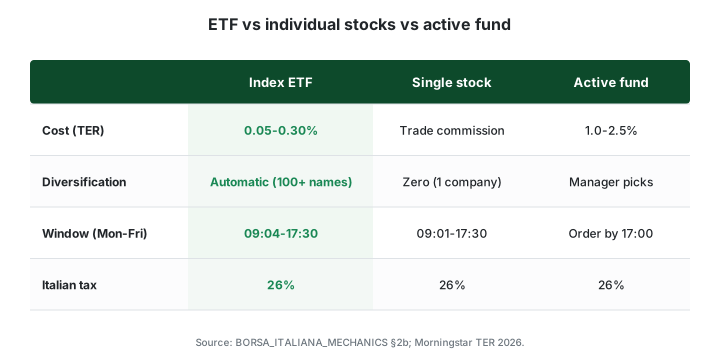
| Typical fee (TER) | 0.07-0.75% | 1.5-2.5% | 0.20-0.50% |
| Italian tax | 26% (redditi di capitale, NO zainetto) | 26% (redditi di capitale, NO zainetto) | 26% (redditi diversi, YES zainetto) |
| Example | VWCE, CSSPX | Arca / Mediolanum / Amundi mutual fund | SGLD (gold), SSLV (silver) |
Warning: a "commodity ETF" (e.g. XAGZ.MI, a UCITS tracking commodity baskets via swaps) is still an ETF, so it's redditi di capitale. An ETC on the same gold (SGLD.MI) is a bond, so redditi diversi. Same gold exposure, opposite tax treatment.
Three cornerstone ETFs Italian investors actually buy
These aren't recommendations — they're the ETFs that show up in practically every "minimalist permanent" Italian portfolio of the last 10 years. Use them as a benchmark to evaluate alternatives:
- VWCE.MI — Vanguard FTSE All-World UCITS ETF (Accumulating)
- ISIN IE00BK5BQT80, TER 0.22%, ~3,700 global companies (developed + emerging).
-
"The single ETF you'd need" per a lot of educational literature.
-
CSSPX.MI — iShares Core S&P 500 UCITS ETF (Accumulating)
- ISIN IE00B5BMR087, TER 0.07%, 500 US companies.
-
Pure exposure to the US market, at world-lowest fees.
-
IWDA.MI — iShares Core MSCI World UCITS ETF (Accumulating)
- ISIN IE00B4L5Y983, TER 0.20%, ~1,500 developed-market companies.
- Like VWCE but without emerging markets.
In our Fanta Finanza game, you can buy all three (and others) with €10,000 virtual capital and see how they behave on real prices.
Common mistakes
- "I bought an ETF, so I'm diversified" — depends on the index. A Nasdaq ETF is 100% US tech. A FTSE MIB ETF is 40% Italian banks + energy. Diversification means "global equity."
- "I pick distributing because I want dividends" — if you have a long horizon and reinvest them anyway, you're donating taxes. ACC is more efficient.
- "VWCE and VWRL are the same ETF" — same underlying index, but VWCE accumulates and VWRL distributes. The choice changes your 20-year outcome.
- "The fund costs 2%, this ETF's TER is 0.20% — roughly the same" — no, it's 10× less. Over twenty years the gap is significant.
- "This ETF's ticker is on .MI so it's Italian" — no, it's listed in Milan but is probably domiciled in Ireland or Luxembourg. Check the ISIN.
Where to learn more (verifiable sources)
- Borsa Italiana — ETFplus section — official list of all ETFs listed in Milan
- Consob — ETFs for retail investors — the Italian regulator's guide
- justETF — comparative database with tax filters for EU residents
- Morningstar Italy — independent research and ratings
This article reflects the law and UCITS definitions as of April 27, 2026.
Sources last verified: 2026-04-27. Legal references and authorities (Agenzia delle Entrate, MEF, TUIR) cited in the article body.
Educational tool, not personalized financial advice. Fanta Finanza is not OCF-registered — details here.