How to Read a Financial Statement: the 5 Numbers That Matter (2026)
"Intesa's financial statement shows a P/E of 7.2 — is that a bargain?" "Eni pays a 6% dividend, should I load up?" "25% ROE, so it's a quality company?"
These are real questions retail investors ask when they start reading fundamentals. The answer is always "it depends" — but it depends on a small, knowable number of other variables, not on some inaccessible alchemy.
This article covers the five numbers that are enough to form an honest view of a stock: where they come from in the financial statements, what they mean in practice, when they lie, and why the bots in our simulation game use exactly these five and not others.
What's in a company's financial statement
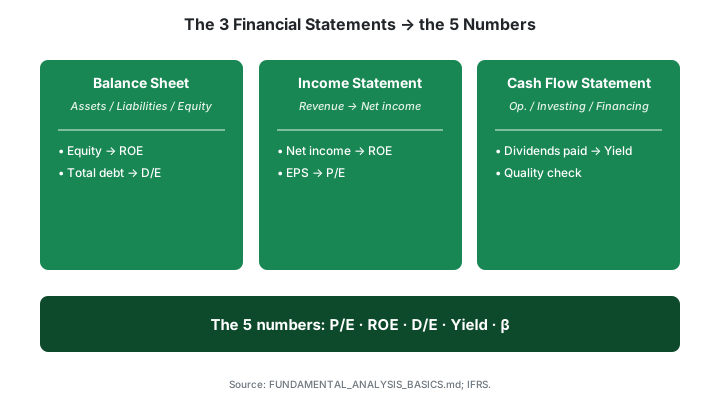
The annual financial statement (bilancio d'esercizio) of an Italian listed company contains three distinct documents, aligned with IFRS accounting standards (mandatory in the EU since 2005):
- Balance Sheet (Stato Patrimoniale) — snapshot of assets, liabilities, and shareholder equity at a given date.
- Income Statement (Conto Economico) — flows of revenue, costs, and profit over a period (usually a year).
- Cash Flow Statement (Rendiconto Finanziario) — actual cash in and out of the business, split into operating, investing, and financing activities.
The five numbers that matter are computed by combining these three documents plus the current market price.
Where to find an Italian listed company's statements:
- Consob EDS (eds.consob.it) — regulated disclosures archive.
- Company website → Investor Relations section (mandatory for all listed firms).
- Ticker page on Borsa Italiana / Euronext Milan, "Annual Reports" tab.
The five numbers
1. P/E — Price/Earnings ratio
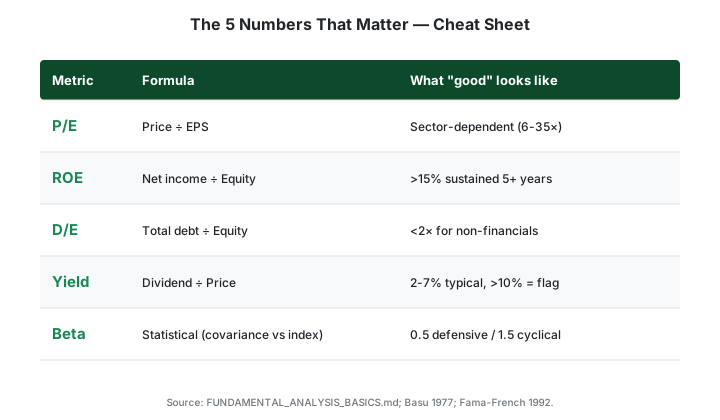
Formula: Price ÷ Earnings per share (EPS).
Tells you how many euros you pay today for each euro of the company's annual earnings. The market quotes two versions: trailing P/E (last 12 months of actual earnings) and forward P/E (next 12 months, based on analyst consensus). Professionals prefer forward, because price discounts the future, not the past.
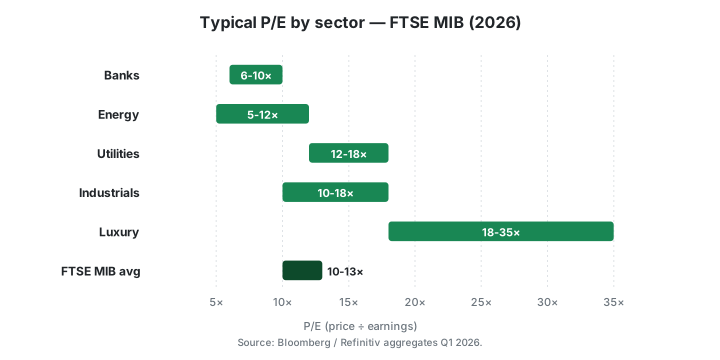
What "good" looks like changes dramatically by sector — a P/E expensive for a utility is a gift for a luxury brand:
| Sector | Typical P/E | Why |
|---|---|---|
| Banks (Intesa, UniCredit) | 6–10× | Cyclical earnings, capital constraints |
| Utilities (Enel, Terna) | 12–18× | Stable, regulated cash flows |
| Luxury (Moncler, Ferrari) | 18–35× | Pricing power + growth |
| Energy (Eni, Saipem) | 5–12× | Commodity cycle |
| FTSE MIB average | 10–13× | Historical |
When it lies: a company that just posted a near-zero profit has an exploding or negative P/E (meaningless). A cyclical firm at peak earnings has a deceptively low P/E right before a collapse (value trap). And IFRS accounting choices on impairments can distort EPS year-to-year.
Academic anchor: Sanjoy Basu (economist, 1977, published in the Journal of Finance) showed on US data that low-P/E portfolios beat high-P/E ones over the long run, even risk-adjusted. This gave birth to the "value factor" in the work of Eugene Fama and Kenneth French (University of Chicago economists; Fama won the 2013 Nobel).
2. ROE — Return on Equity
Formula: Net income ÷ Average shareholder equity.
For every €100 shareholders have in the business (either put in or left as retained earnings), how many euros of profit does the company generate per year? It's the direct measure of how well the company uses its owners' capital.
What "good" looks like:
| Sector | Typical ROE | Notes |
|---|---|---|
| Luxury / brands | 20–40% | Pricing power, asset-light |
| Banks | 6–12% | Regulated leverage; >15% may flag risk |
| Utilities | 6–10% | Regulated returns |
| Industrials | 10–18% | Cyclical |
| Buffett rule | >15% sustained 5+ years | Definition of "quality" |
When it lies: high financial leverage inflates ROE without improving the business (a bank at 40× leverage showing 15% ROE is riskier than a utility at 2× showing 10%). Buybacks shrink the equity denominator → ROE rises without any operational change. Rule: always read ROE alongside D/E.
Academic anchor: Robert Novy-Marx (economist, University of Rochester, 2013) and the five-factor model of Fama-French (2015) formally added profitability (a close cousin of ROE with cleaner accounting) as a fifth risk factor. The historical annual premium (US 1963–2015) is about 3.3%.
3. D/E — Debt/Equity
Formula: Total debt ÷ Shareholder equity.
For every euro of shareholders' capital, how many euros of debt? Measures financial leverage: higher means higher returns in good times and higher fragility in bad times.
What "good" looks like:
| Sector | Typical D/E |
|---|---|
| Banks | 10–20× (different rules — Tier 1 capital ratios matter more) |
| Utilities | 1.0–2.0× |
| Consumer brands | 0.3–1.0× |
| Tech | 0–0.5× (often net cash) |
| Real estate | 2–5× |
| Rule for non-financials | <2.0× |
When it lies: IFRS 16 (since 2019) forced operating leases onto the balance sheet — comparisons with earlier years are apples-to-oranges. For cash-rich firms, net debt (debt minus cash) is more meaningful than gross debt. And D/E should not be used on banks at all — their relevant metric is regulatory capital ratios.
Academic anchor: economists Franco Modigliani and Merton Miller (both Nobel laureates, 1958 paper) proved that in a frictionless world capital structure doesn't affect firm value. In the real world, taxes + bankruptcy costs create an optimum: too little debt wastes the tax shield; too much courts ruin.
4. Dividend Yield
Formula: Annual dividend per share ÷ Current price × 100.
How much dividend income you collect annually as a percentage of capital invested today. Important note for Italian investors: gross is not net. The Italian 26% withholding tax plus any foreign withholding erode 26–40% of the headline cash flow (see our capital gains tax article).
What "good" looks like:
| Sector | Typical yield 2024–25 | Notes |
|---|---|---|
| Italian banks | 8–12% | Capital-return cycle |
| Enel, Eni, Snam, Terna | 5–7% | Utility tradition |
| Italian industrials | 2–4% | Moderate |
| Luxury, growth | 0–2% | Reinvestment mode |
| "Dividend trap" | >10% on non-financials | Market pricing in a cut |
When it lies: the number reflects the past, not the future. Italian banks cut dividends to zero in 2020 (ECB COVID request) — yield-seekers got nothing. US tech companies return capital via buybacks instead of dividends, so yield understates true shareholder return.
Academic anchor: the Gordon Growth Model (named after economist Myron J. Gordon, 1959) is a foundational valuation formula: Price = D₁ / (r − g), where D₁ is next year's expected dividend, r is required return, g is long-run growth. Dividend yield is a direct input to fair value for mature businesses.
5. Beta (β) — Market Sensitivity
What it measures: how much the stock moves when the broad market moves 1%. Not a balance-sheet number — it's estimated statistically from historical prices. But it matters for risk calibration of your portfolio.
Rule of thumb: β = 1 moves with the market, β = 0.5 moves half as much, β = 1.5 moves 1.5× as much, β < 0 moves against the market (rare; gold miners sometimes).
Typical FTSE MIB betas:
| Type | Typical β |
|---|---|
| Utilities (Terna, Snam) | 0.4–0.7 |
| Staples (Campari) | 0.7–0.9 |
| Banks (UniCredit) | 1.2–1.6 |
| Luxury (Moncler, Ferrari) | 1.0–1.4 |
| Oil (Eni) | 1.0–1.3 |
When it lies: beta calculated on a 1-year window can be very different from 5-year. Low beta ≠ low risk — idiosyncratic risk (fires, frauds, individual scandals) is separate. And beta is always relative to a specific index — a BTP has near-zero beta to FTSE MIB but significant duration risk when rates move.
Academic anchor: economist William F. Sharpe (Stanford, 1990 Nobel laureate) in his 1964 CAPM: expected return = risk-free rate + β × market risk premium. Fama and French (1992) later showed beta alone predicts little once size and value are controlled — but it remains the standard market-sensitivity measure.
What we deliberately left out
For a beginner, five internalized numbers beat twenty forgotten ones. These others matter but come later:
- Payout ratio (dividend ÷ earnings). Tells you dividend sustainability. Useful, but yield + ROE often capture it.
- FCF (Free Cash Flow) = operating cash flow − capex. More honest than earnings (harder to "massage" with accounting). First metric to graduate to once the five basics are internalized.
- EV/EBITDA — capital-structure-neutral valuation. Used by M&A pros.
- P/B (Price/Book) — useful for banks and asset-heavy businesses.
- Interest coverage (EBIT ÷ interest expense) — bankruptcy risk; matters in high-rate regimes.
The Fanta Finanza simulation does not use these — we don't pretend otherwise.
Practical checklist — before buying a single stock
Before buying an individual stock (never pick a name just because it sounds familiar or your cousin recommended it), download the most recent Annual Financial Report (from the company's IR page or Consob EDS) and read in this order:
- Income Statement. Revenues growing year-over-year? Stable? Declining? Gross margin stable? Is net income growing faster than revenue (operating leverage) or slower?
- Balance Sheet. Compute D/E. Is goodwill a large chunk of assets? (Red flag: past expensive acquisitions.) Is shareholder equity positive and growing?
- Cash Flow Statement. Operating cash flow positive and roughly matching net income? (If OpCF << NI, earnings quality is suspect.) Sustainable capex? FCF = OpCF − CapEx = the real "take-home" cash.
- Footnotes. The final section is often where the truth lives: related-party transactions, contingent liabilities, accounting-policy changes, management's risk discussion.
- Cross-check the five numbers (P/E, ROE, D/E, yield, β) against at least 3 sector peers. A single number in isolation says nothing.
How it works in the Fanta Finanza game
All 13 Fanta Finanza bots make decisions using a multi-factor model with exactly these inputs: momentum, value (1/P/E), dividend, quality (ROE), safety (1/(D/E+1)), trend (price vs 200-day MA), liquidity, beta.
Each strategy (Il Professore, Il Contadino, Il Value, La Vedova, Il Camaleonte, La Formichina, Il Maestro, …) is a different weight vector over the same factor list. We have no informational edge, no exotic data — we have discipline: apply the same formula to the same numbers every week, without being distracted by headlines or market panic.
If you play Fanta Finanza for a month and watch the bots' decisions, you're running the best practical training in fundamental analysis available: you see why Il Value buys banks at P/E 7, why La Formichina avoids names with D/E > 3, why La Vedova heavily weights dividend yield. Every trade is a concrete application of this article's theory.
Put it into practice for free with Fanta Finanza →
Sources: Basu 1977 (Journal of Finance); Fama-French 1992 and 2015; Novy-Marx 2013; Gordon 1959; Sharpe 1964; Modigliani-Miller 1958; Consob; Borsa Italiana / Euronext Milan; Banca d'Italia. Regulatory and accounting context reflects April 2026. Sector figures (P/E, ROE, yield ranges for FTSE MIB) are as of Q1 2026 and should be re-verified at decision time.
Sources last verified: 2026-05-25. Legal references and authorities (Agenzia delle Entrate, MEF, TUIR) cited in the article body.
Educational tool, not personalized financial advice. Fanta Finanza is not OCF-registered — details here.