Italian Capital Gains Tax in 2026: The Complete Guide
The first question every new investor asks is the same: when I sell at a profit, how much does the State keep?
Short answer: 26%. Real answer: it depends. It depends on the instrument, on your tax regime, on the type of broker, and — for literally the same commodity — even on the legal structure of the product you bought. Getting these distinctions wrong can cost you hundreds of euros a year.
This guide lays out all the 2026 rates on the most common investments, plus the three traps we see tripped most often: the zainetto fiscale (tax carry-forward), the difference between ETF and ETC, and the choice between regime amministrato and dichiarativo.
The imposta sostitutiva: a flat tax that doesn't stack with income tax
Capital gains on financial instruments are taxed under a flat substitute tax (D.Lgs. 461/1997, Art. 5). "Substitute" means two things:
- It's flat: the 26% (or 12.5% on government bonds) applies regardless of your salary. An employee earning €30,000 gross pays the same rate on gains as an executive on €150,000.
- It doesn't stack with IRPEF: investment income lives in a separate tax universe. Progressive IRPEF brackets (23% / 33% / 43% for 2026 under the 2026 Budget Law) apply to salary, pensions, property and freelance income — not capital gains.
This is a favorable regime: someone in the 43% IRPEF bracket on salary still pays only 26% on their stock gains. But it's also rigid: no "brackets" or "deductions" apply on capital gains. The rate is the rate, on every individual transaction.
The 2026 rates by instrument
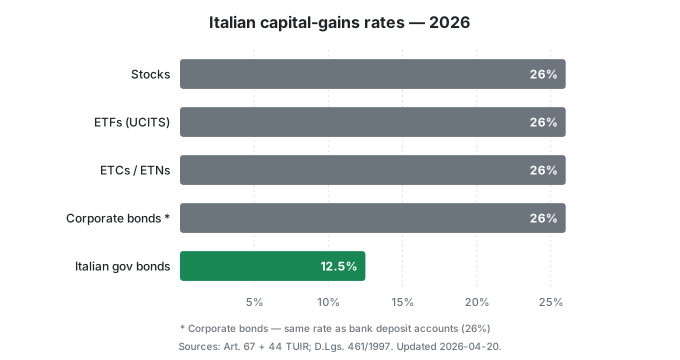
| Instrument | Rate | Category |
|---|---|---|
| Stocks (Italian, foreign) | 26% | Redditi diversi |
| ETFs (UCITS) and mutual funds | 26% | Redditi di capitale |
| ETCs and ETNs | 26% | Redditi diversi |
| BTP, BOT, CCTeu (Italian government bonds) | 12.5% | Redditi diversi |
| Corporate bonds | 26% | Redditi di capitale |
| Dividends (stock, ETF) | 26% | Redditi di capitale |
| BTP coupons | 12.5% | Redditi di capitale |
| Crypto (Bitcoin etc., above €2,000 threshold) | 26% | Redditi diversi |
Sources: Art. 67 and Art. 44 TUIR, Art. 2 c. 6 D.L. 138/2011 for government bonds, L. 197/2022 for crypto.
Three things to notice immediately:
- Italian government bonds (BTP, BOT, CCTeu) pay only 12.5%. Same rate for sovereign bonds from other OECD "white list" countries (US, Germany, France, etc.). It's a historical break introduced to make public-debt financing cheaper.
- ETFs and mutual funds are "redditi di capitale," not "redditi diversi." This distinction is the mother of the zainetto trap in the next section.
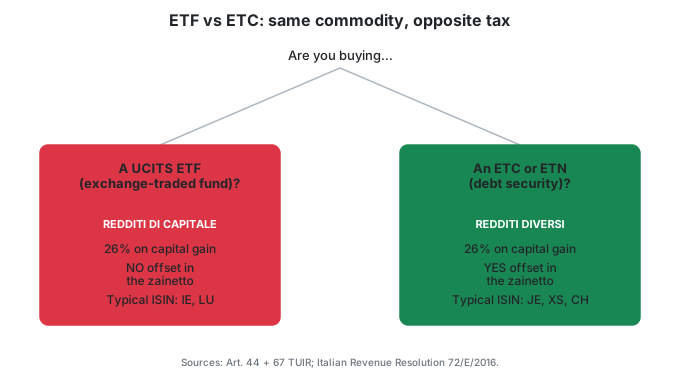
- ETCs are not ETFs, despite the similar name. If you buy SGLD.MI (physical gold), you're buying a bond backed by bullion in a London vault — it's redditi diversi, so zainetto works. If you buy a UCITS "commodity ETF" tracking a swap-based basket, it's redditi di capitale and zainetto does not work. Same commodity exposure, opposite tax treatment.
The zainetto fiscale: how it actually works
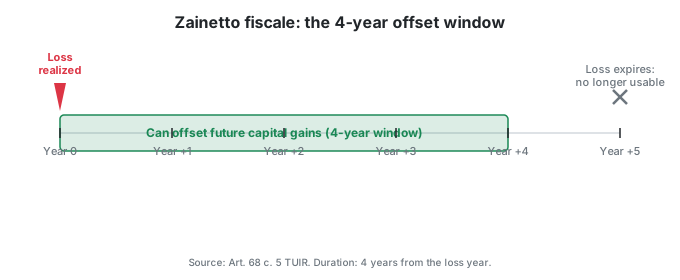
When you sell at a loss, that loss goes into your zainetto fiscale ("tax backpack," Art. 68 c. 5 TUIR). You have 4 years from realization to offset it against future gains. After 4 years the loss expires and you pay full tax.
Here's the part almost no guide gets right: zainetto offsets only redditi diversi against redditi diversi. The real matrix:
| Loss from ↓ / Offset against → | Stock gains | ETF gains | ETC gains | BTP gains |
|---|---|---|---|---|
| Stocks | ✅ | ❌ | ✅ | ✅ (at 48%) |
| ETFs | ✅ | ❌ | ✅ | ✅ (at 48%) |
| ETCs | ✅ | ❌ | ✅ | ✅ (at 48%) |
| BTPs | ✅ (at 48%) | ❌ | ✅ (at 48%) | ✅ |
Sources: Art. 68 c. 5 TUIR, Art. 44 TUIR.
Two critical columns: ETFs never offset each other (both are redditi di capitale), and any offset involving BTPs works at reduced efficiency — 48.08%, the 12.5/26 ratio. A €1,000 BTP gain absorbs only €480.80 of stock losses.
Classic trap: you sell an MSCI World ETF at a €2,000 loss, hoping to offset a future Nasdaq ETF gain. You can't: both are redditi di capitale. The World ETF loss can only offset gains on stocks, ETCs or BTPs. Against other ETFs, the zainetto sits idle until it expires.
2026 note: the Italian Treasury is discussing a reform that would unify the two baskets (redditi diversi + redditi di capitale) and eliminate this asymmetry. Nothing passed yet. Don't plan around the assumption it will.
The ETF vs ETC trap: same gold, different tax
Say you want €5,000 of gold exposure as an inflation hedge. Two common choices on Borsa Italiana:
- SGLD.MI — iShares Physical Gold ETC — a bond issued by an Irish SPV, backed by gold bars sitting in a London vault.
- XAGZ.MI (hypothetical) — a UCITS ETF that replicates a precious-metals basket via swaps.
Both give you gold exposure. Taxwise, they're opposite:
- SGLD = ETC = redditi diversi. Sell at a loss → loss enters zainetto, can offset your gains on Enel or Ferrari.
- XAGZ = UCITS ETF = redditi di capitale. Sell at a loss → loss can only offset other redditi diversi (not other ETFs).
The technical difference: the ETC is debt, the ETF is a fund share. Italian Revenue Agency Resolution 72/E 2016 confirmed redditi-diversi treatment for ETCs.
Quick ID heuristic: check the ISIN. Codes starting with JE, CH, XS are often ETCs; IE and LU are typically UCITS ETFs. When in doubt, read the KIID — it explicitly says whether the product is a debt security (ETC) or a fund (ETF).
Regime amministrato vs dichiarativo: who pays whom
Every broker places you in one of two main tax regimes (D.Lgs. 461/1997 Artt. 5 and 6).
Regime amministrato (default for Fineco, Directa, IWBank, Intesa, Poste)
The broker acts as a withholding agent: on every profitable sale, it withholds 26% (or 12.5%) and wires it to the Treasury. You do nothing at tax time.
- ✅ Practical: zero Quadro RT in your tax return
- ✅ Fiscal anonymity vs. the rest of your return
- ❌ The zainetto is siloed per broker: losses at Fineco don't offset gains at Directa. Close an account → residual zainetto zeroes out.
- ❌ No way to "wait for end of year" and realize offsetting losses — you pay per transaction.
Regime dichiarativo (default for Degiro, Interactive Brokers, Revolut, non-Italian brokers, crypto wallets)
The broker credits you gross. You fill out the Quadro RT on Modello Redditi PF, do the math on your net annual result, and pay by June 30 of the following year.
- ✅ Global offsetting: gains and losses from all brokers, including crypto, flow into a single zainetto
- ✅ You keep the gross until next June (reinvest in the meantime)
- ❌ You now run a tax return every year (Quadro RT, long instructions)
- ❌ You must log every trade: date, quantity, price, commissions, FX rate
Rule of thumb: if you're opening a Degiro or IBKR account thinking "fees will be cheaper than my Italian broker," include the time cost of the Quadro RT. For small volumes (under €10k traded per year) the commission savings often don't pay for the filing work.
Other taxes your investments pay
Beyond the substitute tax on capital gains, two recurring items to keep in mind:
Imposta di bollo on the securities account
0.20% per year on the market value of your portfolio, no exemption (D.L. 201/2011 Art. 13 c. 2-ter). Warning: the "under €5,000 exempt" figure some still quote only applies to checking accounts, not securities accounts. €10,000 in ETFs → €20/year in bollo, even if you don't trade once. Usually the broker deducts it automatically.
Tobin Tax (FTT) — new 2026 rates
The 2026 Budget Law doubled the financial transaction tax rates:
- Italian shares (market cap ≥ €500M) bought on-exchange: 0.20% (was 0.10%)
- Italian shares bought off-exchange: 0.40% (was 0.20%)
Paid by: the buyer, at the moment of the order. Exempt: ETFs, mutual funds, bonds (BTPs included), shares of companies under €500M market cap, market-making. If you buy €1,000 of ENEL you pay €2 of Tobin Tax; if you buy €1,000 of Vanguard FTSE All-World ETF, zero.
Real examples: three investors, three tax bills
Mario, ENEL shares
- Buys €10,000 of ENEL.MI.
- One year later, sells at €12,000.
- Gain: €2,000.
- Substitute tax at 26%: €520 withheld by the broker (regime amministrato).
- If he later closes another stock at a €1,500 loss, the loss sits in zainetto for 4 years. His next gain on a stock, ETC or BTP (at 48%) will absorb it.
Lucia, BTP Valore 6-year
- Buys €5,000 of BTP Valore with step-up coupons averaging ~3.5% gross.
- Average annual coupon: ~€175.
- Coupon tax (12.5%): ~€21.88/year. Net in hand: ~€153.
- Annual bollo (0.20% on €5,000): €10.
- At maturity: redemption at par + loyalty bonus (if held to maturity), ~€50 extra. The bonus is taxed at 12.5% too.
Giulia, MSCI World ETF
- Buys €3,000 of Vanguard FTSE All-World (VWCE.MI — Irish-domiciled UCITS ETF).
- Three years later, sells at €5,000.
- Gain: €2,000.
- Substitute tax at 26%: €520 withheld (same rate as a stock, but the ETF is redditi di capitale).
- Watch out: if Giulia has €1,000 of old losses in her zainetto from other ETFs (redditi di capitale), she cannot use them here. ETF losses only offset gains on stocks, ETCs or BTPs.
- No Tobin Tax on the purchase (VWCE is an ETF, exempt).
- Annual bollo 0.20% → ~€8/year during the holding period.
Common mistakes (and how to avoid them)
- "I sell my losing ETF to offset another ETF's gains": doesn't work. ETFs don't offset each other. Sell only if you have a stock / ETC / BTP gain to offset.
- "26% stacks with my IRPEF": no, it's substitute, not additive.
- "I'll open a Degiro account, same tax regime": no. Degiro is dichiarativo — you file Quadro RT, deadline June 30, all math on you.
- "Under €5,000 in ETFs no bollo": wrong. The exemption is for checking accounts only.
- "Gold ETF has zainetto": depends. If it's an ETC (SGLD, PHAU), yes. If it's a UCITS commodity ETF, no.
Where to verify when the law changes
Italian tax law updates every year through the Budget Law. Authoritative sources, in priority order:
- Agenzia delle Entrate — IRPEF rates and financial-income taxes (Italian only)
- TUIR — consolidated D.P.R. 917/1986
- MEF — Ministry of Economy and Finance (Italian, some pages EN)
- Gazzetta Ufficiale — published legal text
This article reflects the law as of April 20, 2026. If you're reading this in a later year, verify that no intervening Budget Law has changed anything — in particular the 12.5% rate on government bonds is periodically debated in Italian politics.
Important notices
- This article is educational material, not personalized tax or financial advice.
- Fanta Finanza is not OCF-registered (the Italian register of financial advisors) — full disclaimer.
- Tax rates and rules change — this content reflects the law at the date of publication.
- For your specific case, consult your commercialista (Italian tax advisor) or an OCF-registered advisor.
- Numerical examples are illustrative and do not constitute investment recommendations.
Sources last verified: 2026-04-20. Legal references and authorities (Agenzia delle Entrate, MEF, TUIR) cited in the article body.
Educational tool, not personalized financial advice. Fanta Finanza is not OCF-registered — details here.