Dollar-Cost Averaging in Italy: How PAC Works, What It Costs, When It Beats Lump-Sum
On an Italian investing forum, one question gets asked every quarter: "Should I run a €200/month PAC on a global ETF, or wait for markets to drop before I enter?"
It's the wrong question, but it contains the two things worth understanding: what a PAC actually is, and when it makes sense vs the alternative (investing a lump-sum in one shot).
This guide answers both. With real 2026 Italian broker fees, academic evidence (less reassuring than you might hope), and five mistakes we see made over and over.
PAC in one line
A PAC is a fixed cash amount invested at regular intervals (typically monthly) in a chosen financial instrument. You set it up once, then it runs on autopilot: each month the broker debits X euros and buys the equivalent in units of the instrument.
PAC is the Italian application of a global idea called DCA (Dollar-Cost Averaging) or SIP (Systematic Investment Plan). Same mechanic, three acronyms.
Concrete example: €200/month into VWCE.MI (Vanguard FTSE All-World) via a zero-commission broker. On the 5th of every month the broker buys €200 worth of units — more units if the price is low, fewer if high. You don't decide anything, you don't watch the market, you don't "enter at the right time." The idea is precisely to neutralize that kind of decision.
What a PAC costs in Italy in 2026
Everything has changed in the last 10 years. The traditional Italian PAC used to be a bank product with 2-3% entry fees + 1.5-2% annual TER. Today, an ETF-based PAC is a commodity: most dedicated brokers offer it at zero buy commissions.
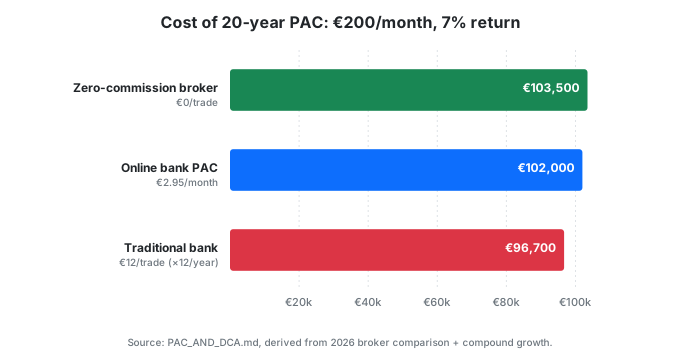
Current landscape (verified April 2026), categorized without naming brokers that would date quickly:
| Broker type | PAC commission | Fractional? | Handles taxes? |
|---|---|---|---|
| Zero-commission mobile broker | €0 (€1 min per plan) | Yes | Yes (sostituto d'imposta) |
| Italian SIM, ETF-focused | €0 on buy | No (residual cash drag) | Yes |
| Online bank with ETF PAC | €0 for under-30, €2.95/mo otherwise | No | Yes |
| Foreign broker (Degiro, IBKR) | Variable, often low | Sometimes yes | No — you file Quadro RT yourself |
| Traditional bank | €5-12 per trade | No | Yes |
Traditional banks are by far the most expensive category. A €200 monthly PAC at €12 per trade means €144/year in fees — a 6% drag on invested capital, compounded for twenty years. The difference vs a zero-commission broker on the same strategy, same ETF, same 20 years, is about €6,800 in terminal wealth.
Tax regime matters as much as fees. "Sostituto d'imposta" means the broker calculates and withholds the 26% for you at sale. Without it (declarative regime, typical of foreign brokers like Degiro or Interactive Brokers) you file Quadro RT in your Modello Redditi PF every year: not dramatic, but an overhead. The upside is a global zainetto fiscale — see the capital gains article for the mechanics.
PAC taxation: nothing special
Common confusion: "does PAC get any tax advantage?" Short answer: no. Italy has no dedicated PAC tax regime. Each instalment is simply a purchase; when you sell, you pay tax on the gain like any other investment.
| What you buy via PAC | Rate on capital gain (at sale) |
|---|---|
| UCITS ETF (equity or bond) | 26% |
| Mutual fund | 26% |
| Italian or foreign stocks | 26% |
| BTP / BOT / CCTeu | 12.5% |
| Pension fund (complementary pension) | 20% on returns, 15→9% at withdrawal |
Each PAC instalment creates a separate tax lot (FIFO: first-in-first-out). If after 10 years you sell 30% of your shares, the broker assumes you're selling the earliest-purchased ones — typically those with the biggest unrealized gain. This means tax falls on the oldest gains first.
There's also the stamp duty at 0.20% annually on the market value of the securities account, from the first euro (no exemption). Small but cumulative: at year 10 of a successful PAC with €40,000 accumulated, that's about €80/year. Not optional.
For the complete mechanics and traps (ETF vs ETC, zainetto fiscale, amministrato vs dichiarativo regime), see the dedicated article: Italian Capital Gains Tax 2026.
PAC vs lump-sum: what the research actually says
Here's where Italian broker marketing and academic research diverge. Marketing says "DCA reduces risk because it buys more when prices are low." Research says: yes, but.
The paper that ruined the party
George Constantinides (economist, University of Chicago, 1979), A Note on the Suboptimality of Dollar-Cost Averaging as an Investment Policy — the foundational paper. Proves that in any market with positive expected return, lump-sum investing dominates DCA in terms of expected value. Empirically replicated by Knight & Mandell (1992/93), Rozeff (1994), Thorley (1994), and many others.
The clearest data point ever
Vanguard (2023), Cost averaging: Invest now or temporarily hold your cash — on real US data 1997-2022, 12-month deployment windows: lump-sum beat DCA roughly 68% of the time. When it lost, it lost by more than DCA's average shortfall — but winning 2/3 of the time is an expected-value signal you can't ignore.
The paper that explains why PAC survives anyway
Meir Statman (economist, Santa Clara University, 1995), A Behavioral Framework for Dollar-Cost Averaging — given that lump-sum wins on numbers, why does DCA remain popular? Statman's answer is behavioral:
- Prospect theory: we feel a €100 loss roughly twice as hard as a €100 gain. DCA caps the maximum regret ("I invested everything and the market crashed the next day").
- Aversion to responsibility: deciding "today is the right day to invest €50,000" is paralyzing. Automatic PAC removes the decision.
- Recency bias: we extrapolate recent trends — market up? "I'll wait for a correction." Market down? "I'll wait for stabilization." PAC forces buying against recency.
- Self-control: automatic payroll deduction accumulates capital that willpower alone wouldn't.
The honest reconciliation
The "PAC vs lump-sum" debate is often a false choice because it's applied to different situations:
- If you already have a lump sum in hand (inheritance, bonus, asset sale): statistically lump-sum wins. If you'll actually do it in one shot, do it. If you think you'd handle a crash the following month poorly, a 12-18 month PAC is the realistic (even if suboptimal) solution.
- If you earn a monthly salary: PAC isn't a choice against lump-sum; it's the natural way you invest. The sum doesn't exist yet at the moment of investment — it arrives every month. The debate doesn't apply.
- If you're building a habit: PAC is the behavioral tool. The alternative isn't lump-sum; it's not investing at all.
When PAC actually makes sense
For those who:
- Earn a regular monthly salary and want to invest a portion of it
- Don't have a one-shot sum to deploy
- Know they wouldn't have the nerve to invest everything at a market top even if they could
- Want to remove the "when to enter" decision from their process
- Have a 10+ year horizon and want to build an automated habit
For those who don't particularly benefit:
- Have a lump sum in hand, long horizon, psychological discipline to absorb volatility — lump-sum is better
- Horizon under 5 years — market risk doesn't justify monthly discomfort
- Want to do "sophisticated market timing" using PAC as cover ("I do PAC but only when the market drops") — that's not PAC, it's trading in disguise
Five mistakes to avoid
- Running a PAC on a mutual fund when an ETF-PAC is available. The TER gap is typically 1.5-2 percentage points per year. Over twenty years it compounds to a 30-40% terminal-wealth gap. Not a subtle issue: that's the difference between €100,000 and €140,000.
- Stopping the PAC during a crash. It's the moment the PAC works most (you buy more units at lower prices). Stopping it turns the behavioral advantage into its opposite.
- Adjusting the amount based on market mood. "Market is down, I'll double the PAC!" / "Too high, I'll pause." That's market timing. PAC works because it's blind.
- Picking a traditional bank for a modern PAC. €12/trade × 12 months = €144/year in fees. Compounded over twenty years: ~€6,800 in terminal-wealth loss vs a zero-commission broker. It's the single highest-impact change available.
- Confusing PAC with Buoni Fruttiferi Postali savings plans. Different products (BFP = Italian postal bonds at fixed rate, 12.5% tax, zero market risk). Both can make sense, but they're not the same.
To wrap up
PAC is a behavioral tool, not a tax alpha or a magical risk reducer. It works because it automates a hard decision (when to invest) and disciplines a hard habit (investing regularly).
Pick a zero-commission broker, a globally diversified ETF, a sustainable monthly amount, and set it running. Then don't touch it for ten years.
The rest — the lump-sum debate, the academic papers, market volatility — is noise compared to that.
Sources and further reading
Internal references:
- Italian Capital Gains Tax 2026 — for the complete 26%-rate mechanics, zainetto fiscale, amministrato vs dichiarativo regime.
- What Is an ETF — the typical instrument around which a modern PAC is structured.
Authoritative external sources (in order of reliability):
- Borsa Italiana — ETFplus for the list of ETFs listed in Italy.
- Consob — ETF guide for retail investors (Italian only).
- Vanguard — Cost Averaging research 2023 for quantitative PAC-vs-lump-sum evidence.
- Constantinides (1979), summarized in Bayes Business School paper — the foundational academic critique of DCA.
- justETF savings plan comparison for 2026 broker fee comparisons.
This article reflects Italian tax law and commercial data as of May 4, 2026. Before making investment decisions, verify current costs directly on the broker's site — the Italian PAC market has changed several times in the last 5 years and will continue to change.
Sources last verified: 2026-05-04. Legal references and authorities (Agenzia delle Entrate, MEF, TUIR) cited in the article body.
Educational tool, not personalized financial advice. Fanta Finanza is not OCF-registered — details here.