10 Most Common Mistakes Italian Beginner Investors Make (And How to Avoid Them)
Across thousands of posts on Italian investing forums (Rankia, ItaliaPersonalFinance on Reddit, various Facebook groups), the same mistakes recur every quarter — with the same results: money lost that shouldn't have been lost.
It's not beginners' fault: these are systematic errors, documented by behavioral finance over the last forty years, backed by peer-reviewed research (Brad Barber and Terrance Odean — UC Berkeley economists, 2000; Daniel Kahneman and Amos Tversky — psychologists, Kahneman won the 2002 Nobel for prospect theory; Hersh Shefrin and Meir Statman 1985 — economists, disposition effect) and public data (Consob, Banca d'Italia, Morningstar).
Ten of them below — the most frequent, the most costly, the ones with the highest damage-to-avoidability ratio. For each: what it is, why it happens, a concrete Italian example, and what to do instead.
1. Keeping too much cash waiting for "the right moment"
The cost: over the past five years, an investor with €50,000 sitting in a checking account lost about 15% of purchasing power to inflation while global markets gained 40-60%. Not a losing bet — it's the cost of not having played at all.
Why it happens: what psychology calls regret aversion. "If I invest today and markets crash tomorrow, I'll blame myself. If I wait and markets fall, I'll blame the market." The second hurts less, so we wait.
The Italian aggravating factor: Banca d'Italia 2024 data shows ~€1,200 billion in household deposits sitting on checking accounts earning near-zero. This is specifically an Italian cultural trait — many other developed countries have 2-3× higher stock-market participation rates.
What to do: separate the emergency fund (3-6 months of expenses on a deposit account) from the rest. The rest goes into an automatic PAC on a global ETF. Remove the decision from the table — see the PAC article.
2. Believing you can "pick the right stocks"
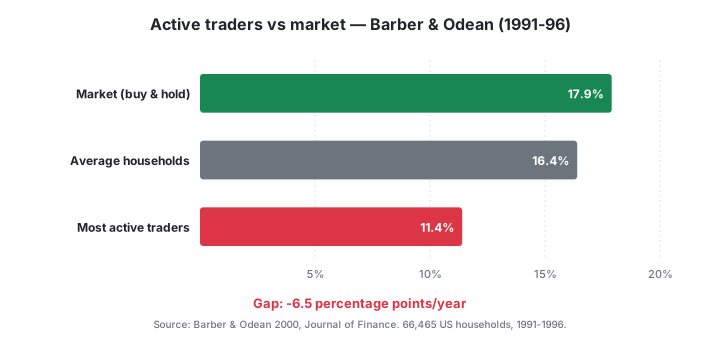
The cost: the Barber & Odean 2000 study in the Journal of Finance analyzed 66,465 US households over 5 years. The most active — those who traded most frequently — earned 11.4% annually while the market returned 17.9%. 6.5 percentage points of annual underperformance. Compounded over 20 years, that's more than a 70% difference in terminal wealth.
Why it happens: overconfidence. We believe we know more than average, even when there's no statistical reason to believe it. 93% of drivers think they're above-average drivers; the investing bias is just as strong.
The Italian aggravating factor: Banca d'Italia produced a dedicated educational video specifically on overconfidence — the bias is common enough to warrant a video from the regulator.
What to do: core portfolio (80-90%) in a diversified global ETF. If you really want to bet on individual stocks, cap at 10% of capital and be fully aware you're playing against the data.
3. "I won't sell until I'm back to even" (disposition effect)
The cost: holding losing positions hoping for recovery, when selling would have been the rational choice. Consob explicitly documents this as one of the most pervasive biases.
Why it happens: disposition effect (Shefrin & Statman 1985). The potential loss "becomes real" only when you realize it by selling. As long as you don't sell, "I haven't really lost" — a false sense of control.
Concrete example: Telecom Italia was €7 in 2000. Those who bought then and waited for a "return to purchase price" are still waiting — today it's around €0.20 (-97% over 23 years). Meanwhile global markets grew 300%+.
What to do: the question isn't "am I back to even?" — it's "at this price, today, would I buy this stock?". If no, you're holding for psychology, not investment. Tax bonus: the realized loss enters the zainetto fiscale and offsets future gains for 4 years.
4. Buying mutual funds when equivalent ETFs exist
The cost: typical Italian equity mutual fund TER = 1.5-2.5% per year. Typical UCITS ETF on the same index TER = 0.07-0.25%. On €50,000 invested for 20 years at 7% nominal, the difference is ~€30,000-40,000 in extra costs with the fund.
Why it happens: status quo bias + familiarity. Your bank pitches the fund; the ETF requires opening a different brokerage account and understanding what it is. Path-of-least-resistance leads to the fund, even when it's 10× more expensive.
The data: S&P's SPIVA study systematically tracks active European funds. Over 15 years, roughly 85-90% of European active equity funds underperform their benchmark. Not because managers are incompetent — because management fees (1.5-2.5%) eat any advantage they generate.
What to do: read the ETF article. If you already have an active fund, weigh exit costs vs the benefit of switching to an equivalent ETF. For new contributions: default to ETFs.
5. No diversification: concentration on Italy / single stock
The cost: annual standard deviation of a single Italian stock: 25-35%. Annual standard deviation of a global index: 15-17%. Similar expected return, double the volatility. You're taking uncompensated risk.
Why it happens: home bias (we prefer what we know) + familiarity (we've heard of Enel more often than of Microsoft).
Proper perspective: Italy represents about 1% of global equity market capitalization and 2% of global GDP. A portfolio 70% concentrated on Italy is overweighting by 70× relative to market-cap weighting. The FTSE MIB index is then further concentrated — about 40% between banks and energy.
What to do: global-index ETF as core (MSCI World, FTSE All-World). Enel isn't more trustworthy than Microsoft just because you've heard of it more often on the Italian news.
6. Panic-selling during crashes
The cost: missing the 10 best trading days over a 20-year horizon cuts total return by about 40%. And those best days cluster right after crashes — not distributed uniformly.
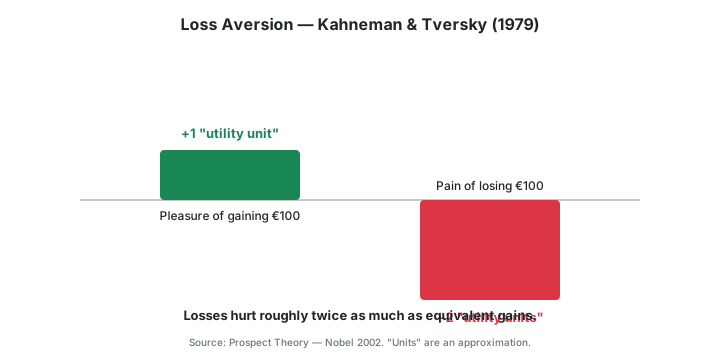
Why it happens: loss aversion amplified by recent volatility. When you see -30% on your portfolio in three weeks, the mammalian brain takes over from the rational one. "Get out, stop the pain."
Recent Italian examples: March 2020 (COVID), October 2022 (ECB rate hikes), September 2008 (Lehman). Each time, Consob/Banca d'Italia data show equity-fund redemption spikes right at local bottoms. Those who sold in March 2020 missed the FTSE MIB's 70% recovery over the following 12 months.
What to do: pre-commit when you're calm. Automatic PAC that keeps buying through crashes (which is exactly when PAC works best, buying more units at lower prices). Separate emergency fund, so a crash doesn't force you to sell.
7. Chasing last year's winner
The cost: Morningstar's 2024 Mind the Gap study measured the difference between fund returns and investor returns (due to entry/exit timing): about 1.7 percentage points per year of "gap" over 10-year horizons. Translation: investors buy after good-performance periods and sell after bad ones — systematically, at global scale.
Why it happens: recency bias and representativeness heuristic. Recent performance seems to "indicate" a trend, even when statistically it doesn't. The advertising engine reinforces it: "Top funds of 2024" lists get widely read and drive flows to last year's winner — which typically underperforms the next year.
What to do: a broad-spectrum global ETF. Don't compare portfolios with friends. Evaluate your allocation annually at most, not monthly.
8. Underestimating the impact of fees
The cost: we computed this in the PAC article. A €200/month PAC on ETF via a traditional bank (€12/trade × 12 months = €144/year in fees) loses about €6,800 in terminal wealth over 20 years vs a zero-commission broker. Small visible sum → large final gap.
Why it happens: availability heuristic. A visible €12 commission "burns" more psychologically than an invisible 0.20% annual fee deducted silently from NAV. Yet the latter, compounded over 20 years, is often more expensive.
Hidden traps: - TER of a fund (deducted from NAV, zero visibility) - Exit fees on some funds (0.5-1% if you leave before N years) - 0.20% annual stamp duty on your securities account (see the tax article) - Bid/ask spread on low-liquidity ETFs (can be 0.2-0.5%)
What to do: calculate effective annual cost BEFORE opening an account. Zero-commission brokers exist for ETF PAC.
9. Confusing product types (ETF vs ETC, certificate vs bond)
The cost: unexpected tax consequences + risk exposure that isn't what you thought it was.
Concrete examples: - You buy SGLD.MI thinking it's an "ETF on gold." It's actually an ETC — taxed as redditi diversi (offsettable in the zainetto fiscale). Here it works out in your favor, but only by luck. - You buy a "bonus cap" certificate thinking it's a form of safe bond. It's actually a non-linear-payoff derivative — if the underlying stock falls below the -30% barrier, you lose 100%, not -30%. - You buy a buono fruttifero postale savings plan thinking it's a PAC in securities. It's actually a Poste Italiane product — fixed return, 12.5% taxation, zero market exposure. Often what you actually wanted, but you should know.
Why it happens: simplified marketing + jargon + not reading the KIID/KID.
What to do: before buying, ask: is it a stock, a fund (ETF or mutual fund), a bond (BTP or corporate), or a structured product (certificate, ETC)? The answer drives both the tax and the volatility. ETF vs ETC + ETF vs mutual fund.
10. Checking your portfolio every day
The cost: no direct monetary cost, but it leads to the previous mistakes. The more you check, the more "losses" you see (equity markets close red roughly 45-47% of trading days), the more stress, the more likely you are to act impulsively.
Why it happens: myopic loss aversion — economists Shlomo Benartzi and Richard Thaler (Thaler won the 2017 Nobel for behavioral economics) in 1995 showed that the more frequently you evaluate an equity portfolio, the more its apparent volatility exceeds the investor's stated risk tolerance. On a daily scale, even a conservative portfolio looks like a rollercoaster; on a five-year scale, the same portfolio looks like a relatively clean line upward.
What to do: quarterly check-in at most. No more often. Disable your broker app's notifications. The correct frequency for reviewing an investment portfolio is closer to a colonoscopy (annual) than to WhatsApp messages.
The common pattern
These mistakes share a theme: confusing action with control. Doing something — buying, selling, checking, waiting for the right moment — gives the feeling of having your hands on the wheel. But in markets, "systematic non-action" (automatic PAC, stable asset allocation, quarterly review) almost always beats frequent action.
The paradox: the successful retail investor makes fewer active choices, not more. Delegates most decisions to rules (PAC, target asset allocation, annual rebalance) and follows them even when "not feeling like it."
In our house bots, the characters that perform worst long-term are often those who mimic these behaviors: La Contraria (buys the losers), Marco YOLO (all in on one trend), Il Dottore (follows recent trend, "performance chasing"). Those that perform best are often the most boring: Prof. Bianchi (passive ETF), Il Maestro (fixed 60/30/10), Il Postino (mechanical PAC). The lesson isn't "those bots are right" — it's that strategies that look like not-doing-anything beat those that look like doing-something-constantly.
Further reading
Internal references:
- What is an ETF — to avoid mistake #4 (mutual funds vs ETFs)
- Dollar-Cost Averaging in Italy — to avoid mistake #1 (waiting for the right moment)
- Italian Capital Gains Tax — to avoid mistake #3 (leverage the zainetto) and mistake #9 (confusing products with different tax regimes)
Authoritative external sources:
- Consob — Behavioral errors and traps — the Italian regulator's guide (Italian only)
- Banca d'Italia — L'economia per tutti, overconfidence video
- Barber & Odean 2000 — the foundational study on overconfidence and retail trader underperformance
This article reflects academic evidence and Italian data available as of May 11, 2026. Behavioral finance is an active field — if new evidence emerges, we'll update the article accordingly.
Sources last verified: 2026-05-11. Legal references and authorities (Agenzia delle Entrate, MEF, TUIR) cited in the article body.
Educational tool, not personalized financial advice. Fanta Finanza is not OCF-registered — details here.