Fanta Finanza vs Fantasy Football: If You Like One, Try the Other
If you've ever played Fantacalcio® (Italian fantasy football, a near-religious experience here in Italy), you've already understood 70% of how Fanta Finanza works. The remaining 30% is the difference between "dribbling in the box" and "BTP-Bund spread at 180 basis points" — it changes everything, but the game structure is the same.
This article is honest about what works in the analogy and what doesn't, and most importantly: what you take home from playing that you don't get from fantacalcio (with love).
Where the analogy works
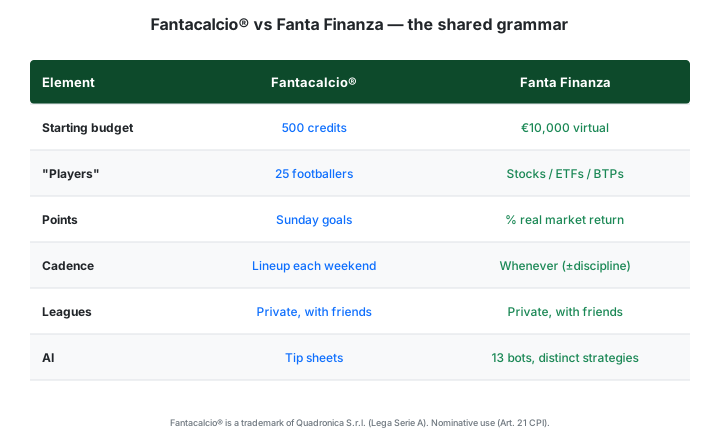
Fantacalcio and Fanta Finanza share the same underlying grammar.
Initial draft
In fantacalcio you start with 500 credits and build a 25-player roster.
In Fanta Finanza you start with €10,000 virtual and build a portfolio of stocks, ETFs, BTPs, ETCs, and deposit accounts. Same logic: fixed budget, mutually exclusive choices, immediate regret when you find out the name you passed over just flew.
Points computed on real performance
In fantacalcio your Leao's points depend on real goals he actually scores, on a real Sunday, in a real stadium.
In Fanta Finanza your Enel's points depend on how much it actually moves, on a real Saturday, on the real exchange. The prices on screen are those of real brokers (with 15-minute delay or end-of-day, depending on tier). No made-up simulations, no invented data.
Weekly moves
In fantacalcio you set your lineup each Sunday.
In Fanta Finanza you can trade as often as you want (with tier-dependent limits to prevent overtrading — one of the 10 beginner mistakes). But the weekly habit is the same: review the roster, shuffle something, adjust exposure.
AI that helps you (or burns you)
More and more fantasy leagues now use algorithms to suggest transfers. We started from AI: you can have a bot play for you (Bot Connector), or compete against our 13 house bots — each with a distinct strategy and a name.
Il Professore applies a peer-reviewed multi-factor model. Il Contadino is a disciplined value investor. La Formichina hates risk. Il Camaleonte switches strategies depending on the market regime. You can study them, imitate them, compete against them — and in doing so learn why a 60/40 portfolio beats the ultra-orthodox Il Professore in a year of bond drawdowns, and loses to him in a flat-rate year.
Leagues with friends
Fantacalcio is fun because you play it with your colleagues.
Fanta Finanza supports private leagues too: invite your friends, create a league, spend three months arguing over why Marco sold UniCredit at €42 ("didn't you see banks were correcting?"). Same social dynamic, financial concepts instead of 4-3-3 formations.
Where the analogy breaks
Worth being honest about limits.
1. Nobody pays Vlahović's salary
Fantacalcio is disconnected from the actual Serie A transfer market. Fanta Finanza is connected to the actual Italian stock market. This is a fundamental difference: what you learn about Intesa's price dynamics, or an MSCI World ETF's behavior, stays valid when one day you decide to buy them with real money. What you learn about Giroud at Milan is... Giroud at Milan.
2. There's no "Fantasy Bonus"
Fantacalcio has arbitrary modifiers ("yellow card: −0.5", "missed penalty: −3"). Fanta Finanza has none: if your ETF does +2.3%, you take home +2.3% minus the tax drag — which is real (26%), not a game modifier.
3. "Transfer windows" don't exist as calendar events
Fantacalcio has the winter mercato di riparazione with bonus credits. In Fanta Finanza you buy and sell whenever you want, without an arbitrary calendar. PAC discipline (Piano di Accumulo del Capitale / dollar-cost averaging, see our article) is your permanent transfer window: buy small amounts, regularly, mechanically, instead of reacting to every rumor.
4. "Goals" aren't discrete events
Football is discrete: you either score or you don't. The market is continuous: Enel doesn't do "+3 goals" on Sunday — it does +0.4%, then −0.2%, then +0.1%, every second of every minute of the trading day. This changes the psychology: fantacalcio rewards weekend anticipation, Fanta Finanza rewards not obsessively watching your portfolio (behavioral finance research: those who check less, earn more).
5. There's no perfect "fantasy coach"
Fantacalcio has journalists and specialized sites telling you "start Dybala, not Berardi". In the real market, gurus exist but statistically err about as often as a coin flip on short-term predictions (see: Mark Carhart 1997 on the persistence of mutual-fund returns, and the Fama-French factor model — named after economists Eugene Fama and Kenneth French — on stock picking). Fanta Finanza teaches you to distrust that category: our bots don't try to "predict the market" — they apply simple, disciplined formulas, week after week.
What you take home
This is the serious part. Fanta Finanza is a game — but spend three months in it, and you'll understand:
The Italian tax system concretely
Not by reading the TUF, but by watching the 26% kick in when you close a capital gain, 12.5% when you sell a BTP, the 4-year delay on the zainetto carry-forward when you hit a loss. When one day you file your first tax return with real gains, you already know what the accountant will ask. Full guide.
Why PAC beats market timing
Not by reading the academic papers of Eugene Fama (the American economist who won the 2013 Nobel for the efficient-markets hypothesis), but by trying to time the market with your €10k portfolio and discovering empirically that you lose to a mechanical €500/month PAC into an MSCI World ETF. The drag of your bets versus the automatic monthly one is a wake-up call. Here's why.
The 5 numbers that really matter
P/E, ROE, D/E, dividend yield, beta. Not as memorized definitions, but seen in action every time one of the house bots buys or sells. After a month you recognize at a glance why Il Value prefers UniCredit at P/E 7× over Moncler at 30×. The academic anchors.
The mistakes to avoid
Nobody reads "12 beginner mistakes" and internalizes them. But making the mistake with virtual money, watching its impact on the leaderboard, and seeing the bot that didn't make it pass you — that's the lesson that sticks. The documented 10 mistakes.
How Borsa Italiana works
When Euronext Milan opens, what changes with T+1 in 2027, why the FTSE MIB is skewed toward banks + energy. The guide.
The honest final caveat
Fanta Finanza is educational. It's not financial advice. It doesn't make you a fund manager. It doesn't prepare you to run a seven-figure portfolio. But it gets you from zero to one in Italian financial literacy, using a method that works (the game) instead of a method that doesn't (the manual you'll never open).
If you're good at fantacalcio, you've already proven you can manage a budget, compare options, adjust strategy. Here you're applying the same skills to a domain that — one day, when you choose — will help you with your actual money.
Start free with Fanta Finanza →
Fanta Finanza is an educational game. It is not an investment service, does not collect capital, does not route orders to real exchanges. We are not registered with the Italian OCF and are not a licensed investment firm (SIM) or bank. Content in the game, the blog, and the documentation is informational and educational only; it does not constitute personalized financial advice or solicitation to invest. For decisions on your actual money, consult a qualified financial advisor. Full disclaimer.
Fantacalcio® is a registered trademark of Quadronica S.r.l. (majority-owned by Lega Serie A since February 2026). The reference in this article is purely descriptive and comparative (nominative fair use under Art. 21 of the Italian Industrial Property Code). Fanta Finanza is not affiliated with, sponsored by, or endorsed by Quadronica S.r.l., Lega Serie A, or Fantacalcio.it.
Sources last verified: 2026-06-01. Legal references and authorities (Agenzia delle Entrate, MEF, TUIR) cited in the article body.
Educational tool, not personalized financial advice. Fanta Finanza is not OCF-registered — details here.